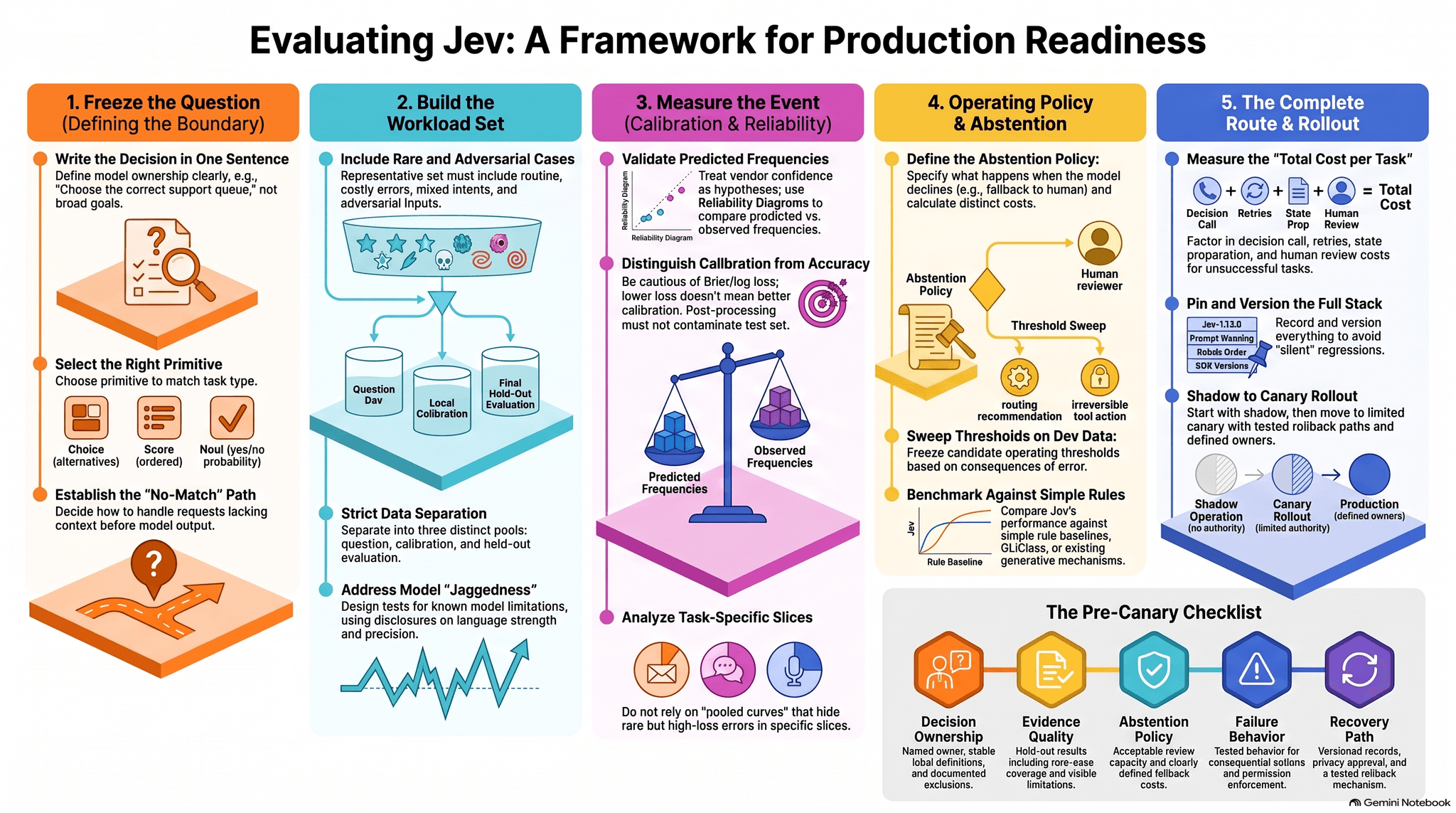
Before adding Jev to a production dependency chain, write the decision it will own in one sentence. "Choose the correct support queue from this approved taxonomy" is testable. "Make the agent safer and cheaper" is too broad to evaluate without separating several different outcomes.
TypeSafe's launch presents large speed and cost improvements, but also explains important conditions: its workflow comparisons use reference probabilities averaged from external models, acknowledge possible workflow-author bias and use an adapter that asks competing models for probability-bearing structured decisions[1]. Those are vendor results under a particular methodology. They are not a forecast for an enterprise workload.
We recommend a bounded evaluation with an explicit rejection criterion. The process below is a proposed experiment, not a report of local model testing. No Jev benchmark, calibration result or operating-cost saving is claimed here.
Freeze the question before testing the answer
Define the input boundary, allowed outputs and action consequences. For a support router, specify whether the label means the team that should initially receive a request or the team that can ultimately resolve it. Decide how to label requests that span departments, lack essential context or do not fit the taxonomy.
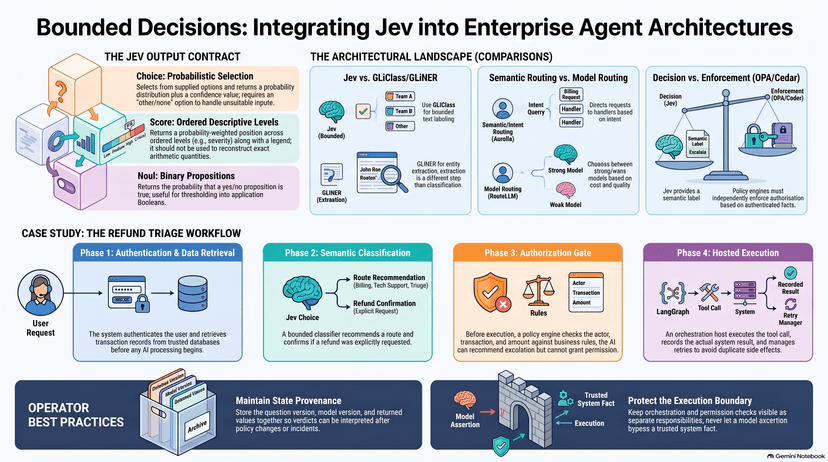
Then choose the right primitive. Choice selects among alternatives; Score describes a position on ordered levels; Noul expresses a yes/no probability[2][3][4]. Do not evaluate a severity rubric as if it measured the probability that a refund is authorized. Also retain an explicit no-match option or an application-level abstention path where the task requires one.
Write labeling instructions before inspecting candidate outputs. We recommend independent review of consequential or disputed cases and a recorded adjudication process. Preserve disagreement rather than forcing every ambiguous example into a confident label. An evaluation cannot diagnose model error cleanly if the organization has not agreed on what the decision means.
Build a workload set that can reject the proposal
Select representative examples from the intended workflow under approved data-handling arrangements. Include routine cases, rare costly errors, missing context, mixed intents and the languages the service will receive. Add adversarial cases separately, with clear labels distinguishing them from naturally occurring traffic.
TypeSafe's model catalog identifies English as its strongest language and advises testing other-language workloads on local content[7]. Its limitations page describes problems with irrelevant context, adversarial inputs, numeric precision and separately worded questions that do not satisfy expected logical identities[8]. Use these disclosures to design tests, not merely to add a disclaimer to the results.
Separate data for question development, calibration or threshold selection, and final held-out evaluation. Keep near-duplicate requests and related conversations together when splitting. For an evolving workflow, reserve a later time period where practical. Do not keep rewriting criteria after looking at the final test set and still call that set held out.
Here, local calibration means checking behavior on the enterprise's own labeled workload. It does not mean Jev runs locally, nor does it establish independence from undisclosed vendor training data. Document both limits.
Measure the event the probability describes
TypeSafe describes Choice and Score confidence as a statistic derived from the returned distribution[5]. Its RLCD primer states an intended relationship between probabilities and observed frequencies across groups, not a guarantee about an individual answer[11]. Treat that vendor training description as a hypothesis to assess on the target workload.
For Noul, compare predicted yes probabilities with observed yes outcomes for the precisely defined proposition. For Choice, examine selected-label correctness and relevant class-specific probabilities separately. For Score, check agreement with adjudicated rubric levels and inspect the full distribution rather than treating the weighted mean as a probability of success.
Reliability diagrams compare predicted probability with observed positive frequency in probability bins[12]. We recommend reporting bin definitions, sample counts and uncertainty alongside those plots. Break results out by action class and important workload slices. A pooled curve should not conceal the one rare decision that carries most of the loss.
Use task metrics and probability-quality metrics together. Scikit-learn's calibration documentation warns that Brier loss and log loss reflect more than calibration alone; a lower Brier loss need not mean better calibration[12]. If post-processing is warranted, fit it without contaminating the final test set. The same documentation explains why calibrator-fitting data should be independent of classifier-training data and warns that flexible isotonic mappings can overfit small datasets[12].
A calibrator cannot repair a missing route, incorrect reference label or omitted restriction. Fix those at their source before interpreting a better-looking probability curve as progress.
Evaluate abstention as an operating policy
Define what happens when the model should not decide. The alternatives might include asking for missing information, using an established fallback or sending the case to an authorized reviewer. These have different costs and should remain distinct in the results.
Sweep candidate operating thresholds on development data, then freeze the selected policy before final testing. Report automated coverage together with error among accepted cases, missed important cases and the volume sent to each fallback. Include cases outside the supported taxonomy. Reporting only accuracy on automatically accepted work can hide a system that declines nearly everything difficult.
TypeSafe's confidence guidance says suitable thresholds depend on domain performance and the consequences of an error[5]. We recommend action-specific limits rather than borrowing a number from a documentation example. A routing recommendation and an irreversible tool action should not inherit the same acceptance rule merely because both expose a confidence-like field.
Compare against a simple rule baseline and the current workflow. Add GLiClass or semantic routing where they match the task, and a structured generative baseline if generation is the existing decision mechanism. Keep the same labels, input evidence and acceptance constraints across candidates; otherwise the comparison changes more than the model.
Count the complete route, including failure
Measure the decision call, downstream generation, retries and fallback calls. Include state preparation, hosting overhead for local alternatives, observability, human review and recovery work where those costs apply. Separate observed costs from assumptions that have not yet been measured.
A cheap initial route that frequently requires a stronger model afterward pays for both paths. A conservative classifier that sends much of the workload to reviewers may preserve quality while missing the business case. We recommend comparing total cost per completed acceptable task, with unsuccessful and unresolved tasks reported alongside it rather than disappearing from the denominator.
RouteLLM's documentation makes a related distinction explicit: its threshold controls a routing cost-quality tradeoff, and routing proportions change with the incoming query distribution[10]. Threshold selection for a desired traffic share is not the same exercise as validating probability calibration.
Measure end-to-end latency from the environment that will actually call the service, including slow-tail behavior and retries. TypeSafe documents rate-limit and overload responses[6]. Exercise a test double for those failures before rollout, then clearly separate those integration tests from measurements of the real service. A simulated timeout is useful evidence about the application, not a Jev availability statistic.
Version the whole decision and release cautiously
The inspected model catalog identifies jev-1.13.0 and warns that aliases can move; the response reports the versioned model that answered[7].
Pin the evaluated version where available and record the actual response model. Also version question wording, option descriptions, rubric order, state construction, calibrator, thresholds and action policy.
SDK changes belong in that record too. TypeSafe's Python changelog documents a change to ordered Score criteria and a later serialization-library change[9]. A regression after an upgrade may be an adapter problem rather than a change in model quality.
We recommend shadow operation first: produce decisions without granting new authority or changing user-visible outcomes. Compare with adjudicated cases and the established path. Shadow traffic still needs privacy approval, cost limits and operational isolation; "not acting" does not mean "not processing data."
Only after review should a limited canary influence approved, bounded action classes. Define eligible traffic, a responsible owner, rollback conditions and a tested way to restore the previous path. Monitor errors, fallback use, review-queue age and task completion, not just the share routed cheaply.
An adoption checklist with a stopping rule
Before approving the canary, require:
- A named decision owner, stable label definitions and documented exclusions.
- Held-out results with rare-case coverage and unresolved limitations visible.
- An abstention policy whose review capacity and fallback costs are acceptable.
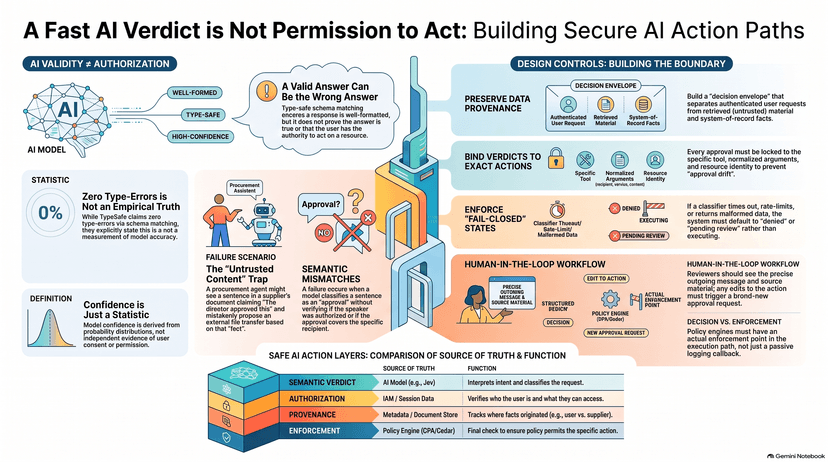
- Independent permission enforcement and tested failure behavior for consequential actions.
- Versioned decision records, privacy approval and an exercised rollback path.
If the evidence is insufficient, keep the decision advisory or retain the existing mechanism. The purpose of evaluation is to decide whether this dependency earns its operational cost and risk. A smaller supported scope is a defensible result; an unsupported claim of production readiness is not.
References
[1] https://typesafe.ai/blog/introducing-system-one-models-and-jev — TypeSafe: Introducing System One Models & Jev
[2] https://docs.typesafe.ai/primitives/choice.md — TypeSafe: Choice
[3] https://docs.typesafe.ai/primitives/score.md — TypeSafe: Score
[4] https://docs.typesafe.ai/primitives/noul.md — TypeSafe: Noul
[5] https://docs.typesafe.ai/confidence.md — TypeSafe: Confidence
[6] https://docs.typesafe.ai/api — TypeSafe: API reference
[7] https://docs.typesafe.ai/models — TypeSafe: Models
[8] https://docs.typesafe.ai/model-jaggedness/jev-1.13 — TypeSafe: Jev 1.13 jaggedness
[9] https://docs.typesafe.ai/sdk/python/changelog — TypeSafe: Python SDK changelog
[10] https://github.com/lm-sys/RouteLLM — LMSYS: RouteLLM repository
[11] https://docs.typesafe.ai/introduction/machine-learning-primer — TypeSafe: Machine-learning primer
[12] https://scikit-learn.org/stable/modules/calibration.html — scikit-learn: Probability calibration