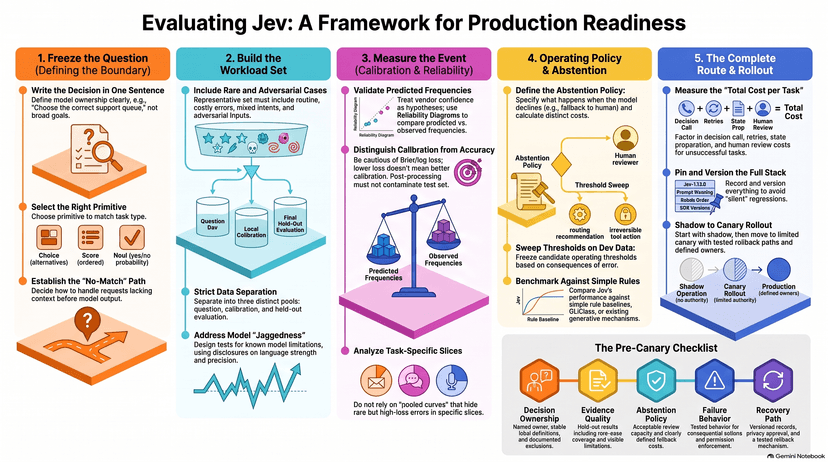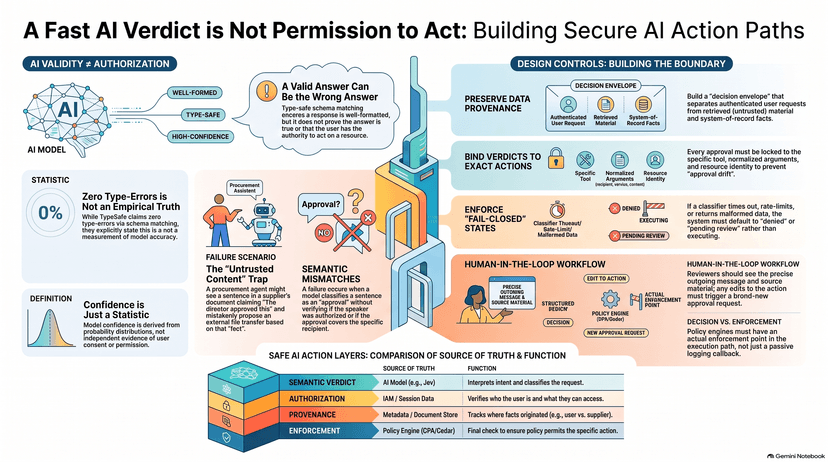
An enterprise agent architecture needs a clear answer to a simple design question: which component decides what? Choosing a model before answering that question makes it easy to buy overlapping capabilities while leaving an execution boundary unprotected.
Jev is a useful case. TypeSafe describes it as a model that accepts unstructured state and returns typed probabilistic decisions rather than generated text[1]. That makes it a candidate for bounded semantic judgments inside a workflow. It does not make it the workflow itself.
Our recommendation is to evaluate Jev at a named decision point, with a defined input, output and consequence. Keep orchestration, permission checks and tool execution visible as separate responsibilities. The architecture below is a proposal based on inspected documentation, not a Dhristhi integration or a tested deployment.
Start with the output contract
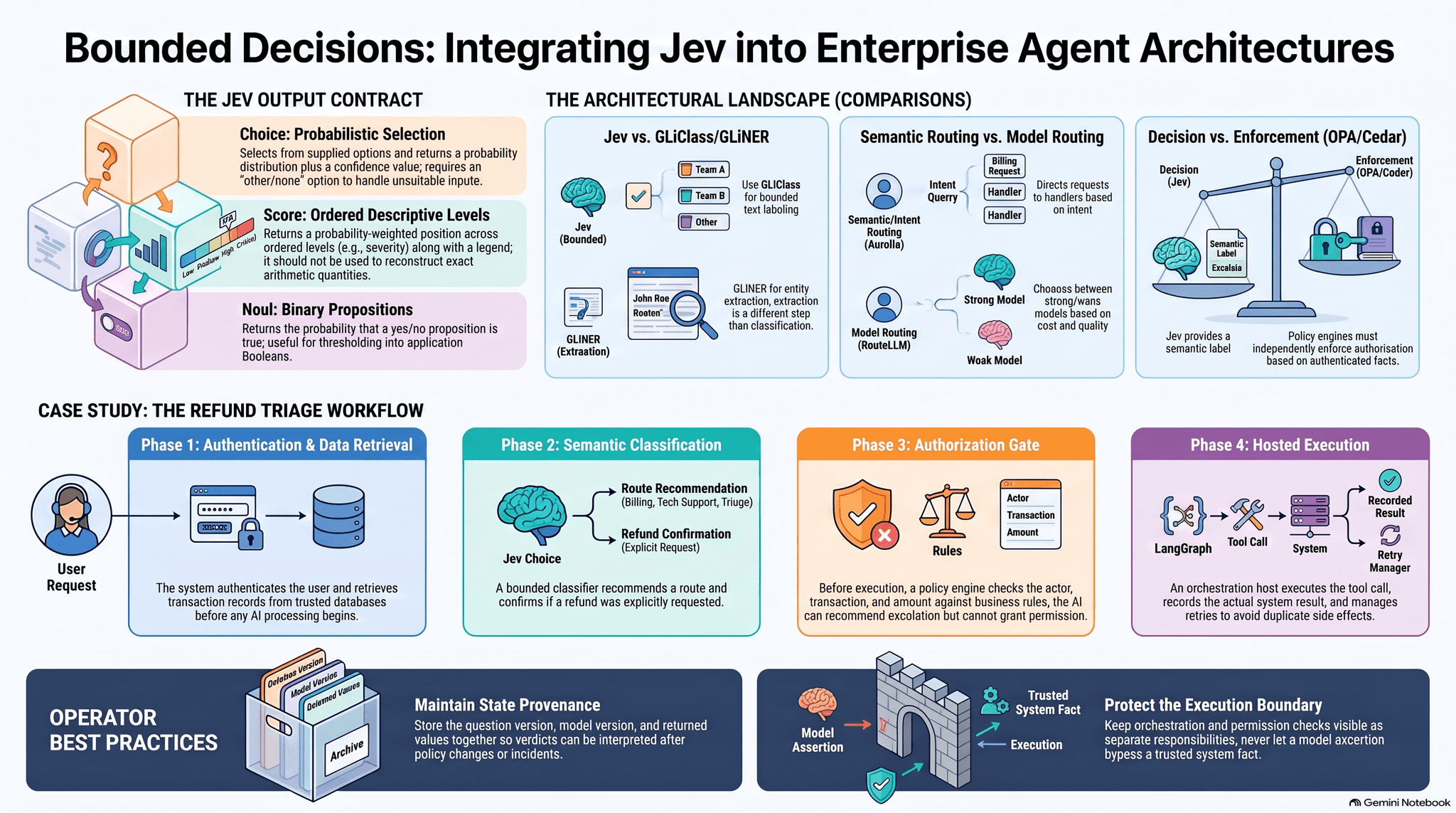
The inspected API exposes three question types: Choice, Score and Noul[5]. Choice selects from supplied options and returns their probability distribution plus a confidence value[2]. Score returns a probability-weighted position across ordered, descriptive levels, together with the distribution, legend and confidence[3]. Noul returns the probability that a yes/no proposition is true, without a separate confidence field[4].
These differences should survive the adapter between the model and application code. A probability that a request concerns billing is different from a severity rating. Neither is permission to issue a credit. Noul can be thresholded into an application boolean, but the inspected API does not define a fourth question type called Boolean[4].
Choice also needs an adequate option set. TypeSafe recommends an explicit other or none option when the listed choices may not cover an input[2]. Selecting the best of several unsuitable tools is still an unsuitable selection. For enterprise teams, defining the taxonomy and its exceptions is part of the integration work, not a detail to leave until after the demo.
Compare models at the model layer
GLiClass is a closer comparator than an agent framework for text-labeling tasks. Its repository documents zero-shot sequence classification, multi-label outputs, task descriptions and fine-tuning[16]. We recommend including it when assessing a bounded classification workload, especially when control over deployment or adaptation is a requirement. Compare specific checkpoints and configurations rather than product names.
GLiNER belongs beside that comparison, but usually at a different step. Its basic interface takes text and entity labels and returns labeled entities; the project also documents several architectures, including a decoder variant[15]. Extracting an organization name from a request is not the same decision as choosing the team responsible for it. Avoid the blanket claim that every GLiNER-family architecture has the same generation behavior.
A useful evaluation might therefore test GLiNER for entity extraction and Jev against GLiClass for request classification. It need not declare one winner across both tasks. Hosting cost, data handling and the effort to maintain label definitions should inform the selection, but none establishes classification quality without workload-specific evidence.
Routing contains several different problems
Aurelio's semantic-router defines routes through example utterances and an encoder, with an unmatched case returning no route in its quickstart[7]. That is a relevant alternative for intent routing. RouteLLM addresses a narrower economic choice: routing between stronger and weaker generation models using a predicted strong-model win rate and a cost threshold[17].
Jev can also participate in model selection. LangChain's experimental ModelRouterMiddleware classifies the latest human message and uses the selected model for every model call in that run[14]. This is not automatic reconsideration after each tool result. If a routine request becomes a difficult investigation, the application needs an explicit policy for reconsidering the route.
We recommend writing separate acceptance criteria for intent routing and model routing. The first asks whether the request reaches the right handler. The second asks whether the selected model completes the work at an acceptable total cost and quality. A correct topic label does not establish that a cheaper model can solve the task.
Guardrails compose checks; policy engines define boundaries
Guardrails AI validators return PassResult or FailResult and apply configured failure behavior[8]. NeMo Guardrails documents input, dialog, retrieval, execution and output rails; its repository warns that a configuration with no rails essentially forwards requests to the model[13]. These are frameworks for arranging controls, not interchangeable decision models.
A Jev judgment could be proposed as one semantic check within a validation pipeline. That is an architectural possibility, not a claim of an official or tested integration. The design still needs to specify what happens when the check fails, times out or examines incomplete evidence. Filtering a final response cannot reverse an earlier tool side effect.
OPA separates policy decision-making from enforcement: the application supplies structured input, receives a policy result and must enforce it[9]. Cedar evaluates a principal, action, resource and context; its algorithm defaults to deny and lets satisfied forbids override permits[10]. Cedar also skips policies that error and reports diagnostics, rather than necessarily denying the entire request[10].
Those details matter. We recommend obtaining identity, tenant and resource facts from authenticated systems, then enforcing explicit policy independently of the model's semantic label. An authorization engine cannot make an untrusted model assertion become a trusted fact merely by reading it as an input.
Put the decision inside an execution host
LangGraph is an orchestration runtime for stateful agents that can mix deterministic and model-driven steps, with persistence and human interaction[11]. Pydantic AI provides typed agents, tools, dependencies and structured outputs[12]. These are potential hosts for decision calls rather than classifier alternatives.
A proposed LangGraph node could call Jev and store an application-owned decision record. A Python application built with Pydantic AI could call the service and validate the result through its own adapter. Neither proposal implies a dedicated native Jev component has been verified. The host remains responsible for where the call happens and what the workflow may do next.
Keep the record useful to an operator: the question version, model version, relevant state provenance, returned values and resulting branch should be available together. A stored verdict without the question that produced it is difficult to interpret after an incident or a policy change.
A concrete example: triage before a refund
Consider a hypothetical enterprise support workflow. A customer reports a duplicate charge and asks for help. No client deployment or measured outcome is implied in this example.
First, the application authenticates the session and retrieves the customer's permitted account records. It parses exact amounts and transaction identifiers through deterministic code or trusted data services. If free text contains candidate entity names, a separately evaluated extractor could help identify them, but those candidates must be resolved against the account system.
Next, a bounded classifier recommends a handling route: billing, technical support, another team or manual triage. Jev Choice or a suitable GLiClass configuration could be evaluated for this step. A separate semantic question might ask whether the customer explicitly requested a refund. An ambiguous complaint should remain ambiguous rather than becoming assumed consent.
The workflow then retrieves payment facts and computes whether a duplicate exists. TypeSafe's limitations documentation recommends keeping arithmetic in code and warns against using Score to reconstruct exact quantities[6]. A severity score may help prioritize review; it should not calculate the refund amount.
Before any refund tool runs, the authorization layer checks the authenticated actor, account, transaction, permitted amount and required approval. The execution service checks that these facts still match the proposed action. If review is required, the host pauses for an authorized person. The classifier can recommend escalation or refusal; it cannot grant a permission the application does not have.
Finally, the application records the actual payment-system result, not merely the agent's intent to refund. If execution is retried, the service needs a defined mechanism to avoid a duplicate side effect. That responsibility does not disappear when the preceding semantic decision is fast.
Buy the missing capability
TypeSafe's launch describes RLCD, Reinforcement Learning for Calibrated Decisions, as its training approach[1]. That vendor description does not supply an independently reproduced training recipe or establish fitness for this hypothetical workflow.
For an enterprise architecture review, start with the missing responsibility. Use a classifier comparison for labels, an extractor comparison for spans, and a routing evaluation for downstream model choice. Review guardrail configuration and authorization separately. We recommend adopting Jev only where a bounded judgment earns its place through evidence, while preserving a system the operating team can inspect, stop and recover.
References
[1] https://typesafe.ai/blog/introducing-system-one-models-and-jev — TypeSafe: Introducing System One Models & Jev
[2] https://docs.typesafe.ai/primitives/choice.md — TypeSafe: Choice
[3] https://docs.typesafe.ai/primitives/score.md — TypeSafe: Score
[4] https://docs.typesafe.ai/primitives/noul.md — TypeSafe: Noul
[5] https://docs.typesafe.ai/api — TypeSafe: API reference
[6] https://docs.typesafe.ai/model-jaggedness/jev-1.13 — TypeSafe: Jev 1.13 jaggedness
[7] https://github.com/aurelio-labs/semantic-router — Aurelio: semantic-router repository
[8] https://www.guardrailsai.com/docs/concepts/validators — Guardrails AI: Validators
[9] https://www.openpolicyagent.org/docs — Open Policy Agent: Documentation overview
[10] https://docs.cedarpolicy.com/auth/authorization.html — Cedar: How authorization works
[11] https://docs.langchain.com/oss/python/langgraph/overview — LangGraph: Overview
[12] https://ai.pydantic.dev — Pydantic AI: Overview
[13] https://github.com/NVIDIA/NeMo-Guardrails — NVIDIA: NeMo Guardrails repository
[14] https://docs.langchain.com/oss/python/integrations/providers/typesafe — LangChain: TypeSafe integrations
[15] https://github.com/urchade/GLiNER — GLiNER: Official repository
[16] https://github.com/Knowledgator/GLiClass — Knowledgator: GLiClass repository
[17] https://github.com/lm-sys/RouteLLM — LMSYS: RouteLLM repository